Boy mom and OB/GYN Dr. Shannon Brim shares her own experience and advice for how to talk to your boys about periods.
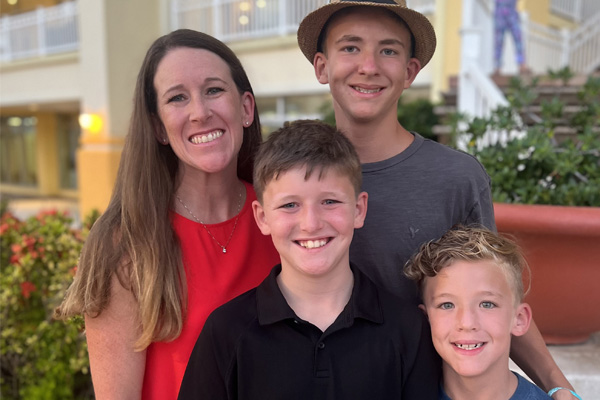
As a mom of three boys ages 9, 12, and 15, and a gynecologist, I know a thing or two about the menstrual cycle – AKA periods – and I ALSO know that boys want to avoid conversations about it at all costs. When I had one of my sons trapped in the car on the way to soccer practice, I told him I was asked to write an article about how to talk to boys about periods. “Mom, why would anyone want to read an article about periods?” was his response. Pressing on, I wondered if there was anything related to the subject he had questions about or wished I would answer for him. You’re not wrong in assuming the resounding silence and “ugh… moooommm (eyeroll),” he uttered meant that no, no he did not. BUT that doesn’t mean it isn’t important for them to know about it!
Well, how should we talk to boys about a girl’s period? When should we start this conversation? What if it’s awkward? What if I’m too shy or embarrassed? In this article I’ll give you my real-life answers to these questions and my approach with my own sons.
Timing
When one of my boys was maybe three, he found a box of tampons under my sink, pulled them all out of their wrappers and inserters and started playing with them because they looked like “fish.” It was then I realized that it’s never too early to start talking to your kids about our bodies and the differences between boys and girls. We always have used real, anatomic terms to describe “private parts,” but even I was stumped about how to tell my three-year-old where the tampons actually go and what I used them for in a way he would understand.
The timing will depend on your son and his curiosity as well as maturity. If you go by his cues, you can’t go wrong here! My advice is to be open, honest, and direct. Answer his questions. You don’t have to have the birds and the bees talk just because he finds a tampon in your purse, but you should probably make sure he knows that it isn’t a fish.
Many of the counties around Richmond participate in Family Life Education in public schools. Boys and girls will be separate for most of it. In 5th and 6th grades, boys will begin to learn about puberty and periods in these classes. This may mean that your boys don’t have any questions for you because they are being answered at school. For some parents this may be a relief. For some, it can be a time for exploration of topics. Just know that your boys won’t be naïve to the subject matter by the time they are around ten or eleven.
What are periods?
Periods are a sign of puberty in girls. Boys will understand what a sign of puberty is because they seem to be obsessed with where their body hair is sprouting. A period is the time, usually once a month, where girls have vaginal bleeding. But don’t worry! This bleeding isn’t like bleeding from a cut. It’s from the lining of the uterus – the place where babies grow. Periods usually last 4-7 days, although this is different for each girl. Having a period means that a woman isn’t pregnant but could be. The blood comes out to prepare the body to potentially become pregnant the next month.
Explain to your sons that having a period is normal, natural, and not a reason to worry for their sistersand friends. Reassure them that girls can still do normal things when they are on their periods. They normally don’t have to miss school or activities.
Why don’t boys have periods?
Well, the easy answer is that boys don’t have a uterus. They physically can’t have a period. Lucky them.
What do girls do about bleeding?
Usually, the bleeding isn’t super heavy. In fact, most of the time girls can’t even feel the blood coming out. They can use pads that go inside underwear to catch the blood, or they can use tampons (NOT FISH). Tampons go inside the vagina (the tube from the uterus to the outside of the body) to catch the blood before it comes out. There are also special period panties girls can wear that absorb the blood and keep it from getting on their clothes.
Don’t be afraid to show your kid these items if they haven’t already found them in your bathroom cabinet!
Sometimes, though, the blood is too much for the pads, tampons, or panties, and it might get on a girl’s clothes. Please tell your boys that this can be embarrassing, but it is OK! She might have to change her clothes – BUT – if you see a girl with blood on her pants, please don’t make a big deal about it to other people! Maybe offer her your hoodie to cover up and help her get to the nurse to call someone. She will be so grateful!
Do periods hurt?
Not usually, but the uterus is a muscle! During a girl’s period, the uterus works really hard, so cramping is pretty common. Imagine doing 100 pushups. Your muscles would be sore, too! Usually a heating pad and some over the counter medicine help make it better.
When do periods start?
This can be different for everyone. Most girls will start their period by age 12-14, BUT some get it as young as nine years old! Just like all boys will hit their growth spurt at a different age, or grow a mustache at a different age, girls will start their periods at different ages. Some will be early bloomers and others will take more time.
Why do girls get mean on their periods?
Well bud, this is the gift of hormones. Hormones are chemicals in our bodies that tell our body what to do. For boys, testosterone is the hormone that helps boys grow tall, grow body hair, deepen their voice, etc.
Girl’s hormones, estrogen and progesterone, change levels throughout the month depending on where the body is in its menstrual cycle. In addition to telling our bodies when to grow a lining in the uterus and when to have a period, the changing hormones can also make us angry, sad, irritable, or snippy. It can feel very confusing and unsettling to have mood changes for what seems like no reason. These changes are particularly common around the start or right before the period. This is called PMS (Premenstrual Syndrome). Please be kind and gentle to us during this time. Nothing gives a girl the right to be downright mean, but maybe offer her a little extra grace.
Why Explaining Periods To A Boy Is So Important
If you’re open and honest with your son about things like finding a tampon in your purse when he’s little, he might be more comfortable about coming to you with trickier questions and concerns as he gets older. Rather than shying away, use those little opportunities to get the conversation rolling. It’ll probably be awkward at first, but it’ll sink in that periods are a normal part of life for girls, not a taboo phenomenon never to be discussed. Addressing his questions as they come up will also help you become more comfortable discussing the topic. Try asking him what he already knows about periods…you might be surprised what misinformation he’s heard that you’ll want to clarify.
Tips for breaking the ice
Especially as they get closer to puberty themselves, boys will probably squirm when you start the conversation face to face. You can try bringing it up in the car where you don’t have to look at each other as you talk. Another idea is to try having him email you his questions or write them down in a journal that you could respond to and leave for him to read.
If the idea of talking about periods and puberty with your son makes you want to run and hide as much as he does, try not to worry! There are plenty of books out there to help get you started. You can even leave a book on his nightstand to peruse at his own pace. I just recommend reading it first!
No matter how awkward the conversation – if you’re opening the lines of communication, you’re helping your son have a healthier perspective on periods!
To make an appointment with an OB/GYN provider at one of our Richmond, VA, locations, call VPFW at 804-897-2100 or message us to schedule online.
Last updated April 7, 2026