Understanding the basics when it comes to breast health can go a long way in helping you live a full, healthy life. Every woman should make self-exams and breast checks with their ob/gyn a regular part of their health care routine. Women over 40 should add annual screening mammograms to that routine care. You should also be sure to discuss your breast cancer risk factors with your doctor.
Breast Cancer Facts
- Breast Cancer is the second leading cause of death among women.
- 1 out of every 8 women will likely develop breast cancer
- If caught early, the 5-year survival rate is almost 100%
- Mammography has helped reduce breast cancer mortality in the United States by nearly 40% since 1990
- 3/4 of women diagnosed with breast cancer have no family history of the disease and are not considered high risk
- Each year it is estimated that over 252,710 women in the U.S. will be diagnosed with breast cancer and more than 40,500 will die
- Although breast cancer in men is rare, an estimated 2,470 men will be diagnosed with breast cancer and 460 will die each year
Signs and Symptoms of Breast Cancer
- A new lump, hard knot or thickening
- Nipple retraction (nipple pulling in)
- Skin dimpling (sometimes looks like an orange peel) or puckering
- Swelling of all or part of the breast, not related to the menstrual cycle
- Redness, scaling or thickening of the nipple or breast skin
- Nipple discharge that starts suddenly (do not try to squeeze nipple)
- New pain in one spot that does not go away
If you notice any of these symptoms, schedule a breast check with your doctor. If needed they will help schedule a diagnostic mammogram.
What is a screening mammogram?
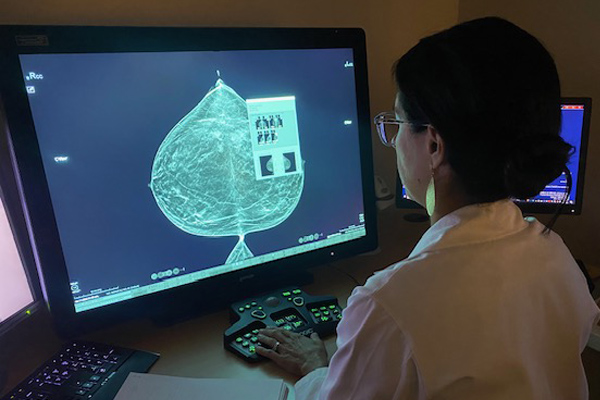
Women who do not have any symptoms receive a screening mammogram to check for abnormalities. We recommend annual screening mammography for women 40 and over and for younger women with risk factors for breast cancer.
Our facility performs 2-D and 3-D screening mammography. Compared to a 2D mammogram, a 3D mammogram displays more images of the breast and in thin sections of breast tissue. The 2D mammogram image takes one shot and with the 3D, the unit will sweep over the breast and take a series of images.
What is a diagnostic mammogram?
A diagnostic mammogram is performed on women who have a mass or other signs/symptoms of a breast problem. The procedure is similar to a screening mammogram, however, several additional views may be performed. We do not perform diagnostic mammograms in our office. Your physician must order a diagnostic mammogram for you.
Benefits of 3D mammograms
- 3D mammography finds 20-65% more invasive breast cancers than 2D alone
- More accurate detection by minimizing the impact of overlapping tissue
- Better detection in dense breast tissue; 3D takes images from multiple angles which offers a better view through dense breast tissue
- Less anxiety: 3D imaging can help reduce false alarms
- Safe and effective: during a 3D mammogram, women will experience a minimal amount of additional radiation compared to a 2D mammogram. This dose is below the FDA regulated limit for mammography and is not associated with additional risks. FDA studies proved that the benefits outweighed any potential risk before approving 3D mammography.
What Should You Expect During Your Mammogram?
Since the 1980s, doctors have used mammograms for breast cancer screenings. During a mammogram, the xray machine briefly compresses the breast in two different positions. The total exam takes about 10 minutes. Sometimes your mammography technician will take extra images to include all of the breast tissue. The compression helps spread out the breast tissue and reduces the amount of radiation needed to produce excellent images. It also reduces any chance for motion on the image. If the patient chooses to have a 3D mammogram, the unit will sweep over the breast and take a series of pictures. A radiologist (a doctor who specializes in reading xrays) will read the mammogram and the results are sent to the patient by letter.
To make an appointment with an OB/GYN provider at one of our Richmond, VA, locations, call VPFW at 804-897-2100 or message us to schedule online.
Last updated March 12, 2026